
Home " Oxygen plants " Red watercress
TL;DR | The red waterfern (Veronica catenata) is a native riparian plant with pink flower clusters and red-tipped stems. This striking plant grows well in wet banks, puddles and slow-flowing streams, and contributes greatly to biodiversity thanks to its attraction to aquatic insects. Ideal for nature-friendly ponds and ecological gardens.
Order it directly through our partner: Ordering red watercress from Pond Master.
The red watercress, or Veronica catenata, is a robust and graceful aquatic plant that stands out for its elongated leaves and small pink flowers. The flowers appear in clusters in the axils of the leaves, and the stems may be purplish-red in colour. This plant belongs to the Libra family and often grows in lush groves on the bank.
Although less well known than its blue relative (Veronica anagallis-aquatica), the Red Watercress offers at least equal ornamental value, especially when in bloom between May and September.
Order easily via our partner: Ordering red watercress from Pond Master.
This species is native to many areas of Europe, North America and parts of the African continent. In the Netherlands, it is fairly common in the west and the river area, but rarer on nutrient-poor sandy soils. It prefers to grow in wet to very wet conditions such as marsh zones, ditch banks and pools.
This species tolerates slightly brackish water and copes well with temporary drought, making it stand out well even in varying water conditions.
This plant is a valuable addition to ecological ponds. Red water grass attracts macrofauna, such as small aquatic insects, larvae and other invertebrates. Thanks to its ecological role, this plant provides food and hiding places for small aquatic animals, contributing to a stable and healthy aquatic environment.
In addition, the dense underwater structure provides hiding places for young fish and the plant contributes to oxygen production.
Red watercress requires little maintenance. It develops well in clay soil or special pond substrate, but can also be placed in a basket if desired. For optimal results, planting in the marsh zone or shallow banks is recommended.
The plant does well in nitrogen-rich and calcareous conditions, and is hardy. In drought or heat, above-ground parts may temporarily wilt, but under favourable conditions the plant recovers quickly.
Red watercress can be recognised by:
Compared to the Blue Water Plant, this variety has smaller flowers of 3 to 5 mm and noticeably longer flower clusters. The plant is sometimes mistaken for the widely used Lidsteng, but Red water plantain is more visually attractive and ecologically valuable.
It is particularly suitable for natural ponds, marshy banks and pond edges. Thanks to its modest height (10-60 cm), it remains manageable, while the colourful flowers and shades of red in the leaves make for a striking appearance.
Use Red water-herb as a transitional plant between water and bank, and combine it with species such as Big water-herb, Marsh forget-me-not or Swan Flower for a natural-looking, flowering bank.
For good coverage, we recommend using 5 to 7 plants per linear metre of pond edge. Place Red Watercress in a sunny spot in the pond and use nutrient-rich substrate or pond soil to encourage profuse flowering.
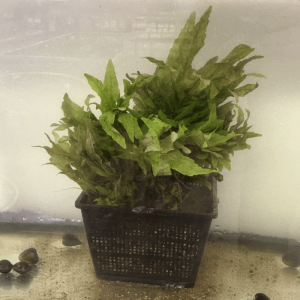
Red watercress can be ordered through our sales partner Vijvermeester.nl.
Zuurstofplanten.net is a website of Dutch Water Tech. Specialist in water treatment for municipalities and water boards. Would you like to know more? Visit dutchwatertech.co.uk for more information on our projects.
Dutch Water Tech BV
Gateway 1
4613 BW Bergen op Zoom
You can buy oxygen plants, bank plants and other pond products through our partner Vijvermeester.nl.
© 2025 Dutch Water Tech. All rights reserved.
 English (UK)
  Nederlands
  Deutsch
  Français